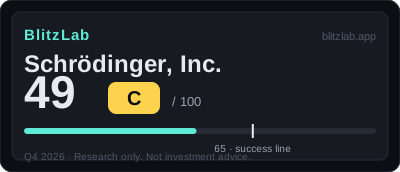
Schrödinger, Inc. — Blitz Index 49 (C)
Schrödinger scores 49 — all of the top 20 pharmaceutical companies license its physics-based platform and Q3 ACV re-accelerated 17%, held back by 4.8% trailing revenue growth, a software gross margin sliding from 81.5% to 74.4%, and a nine-month operating cash outflow of $96.5M against $373.4M of cash.
Last re-scored: November 4, 2026.
Confidence: Medium · Category: frontier
Score breakdown
| Section | Score | Detail |
|---|---|---|
| A · Speed | 15 / 25 | Trailing revenue +4.8% YoY and FY2025 ACV up only 4.0% — but Q3 ACV re-accelerated 17% (24% excluding contribution ACV) and FY2026 guidance was raised to $222–232M |
| B · Moat | 29 / 60 | All top 20 pharmaceutical companies license the platform and large customers expanded average ACV 18% — but no platform lock-in, and a 74.4% software gross margin sliding from 81.5% |
| C · Creative destruction | 11 / 15 | Physics-based computation displacing trial-and-error wet-lab drug discovery across a $250B-plus annual pharma R&D wallet — with Bunsen, the AI co-scientist, opening the next behavior change |
| D · BlitzFailing | −6 | No debt and $373.4M of cash, but a $720.6M accumulated deficit, milestone-lumpy revenue, mark-to-market equity swings, and a nine-month operating cash outflow of $96.5M — well below the FLAG line |
Think we scored it wrong? Score it yourself →
Radar axes (0–100): Moat 48.3 · Speed 60.0 · Creative 73.3.
Watch item
Gates: G1 ✓ (confirmed — all top 20 pharmaceutical companies licensed, ACV re-accelerating to +17% in Q3 2026, $151.2M of deferred revenue) · G2 ✓ (confirmed — even the narrowest 2030 market definition, AI drug discovery at $7.42B, is 2.8 times the $2.69B bar, and the molecular modeling extrapolation to 2036 is about $50B). 16 points below the 65-point threshold — the destruction thesis is strong, but speed is modest and margins are sliding. Watch whether the Q3 ACV re-acceleration holds into FY2026 guidance of $222–232M, whether Bunsen's full commercial launch lands by year-end, and whether the software gross margin stops falling from 74.4%.
Strengths
- Standard adopted by every large drugmaker: all top 20 pharmaceutical companies licensed in 2025, 37% of software revenue and 41% of ACV
- ACV re-acceleration: Q3 2026 ACV $44.7M (+17% YoY, +24% excluding contribution ACV), trailing four-quarter ACV $214M, FY2026 guidance raised to $222–232M (+12–17%)
- Hosted transition: hosted revenue +49% YoY to $17.2M, 45% of quarterly software revenue
- Bunsen AI co-scientist: early access in July 2026, strategic agreement with BMS to deploy it in September 2026, full commercial release expected by year-end 2026
- Clean balance sheet: no debt, $373.4M of cash and marketable securities, $241.1M of ATM capacity unused, KPMG unqualified opinion and effective internal controls
Concerns
- Modest growth: trailing revenue +4.8% YoY, FY2025 ACV up only 4.0%, Q3 software revenue +6.2%
- Margin slide: software gross margin 81.5% in FY2023 → 74.4% in FY2025, consolidated margin 64.9% → 55.7%
- Persistent losses: nine-month operating loss of $116.5M, net loss of $91.8M, accumulated deficit of $720.6M
- Cash burn: nine-month operating cash outflow of $96.5M — about 2.9 years of runway at the current burn rate
- Milestone-lumpy revenue: drug discovery revenue swung −52.8% then +107.4% year over year, and Q3 2026 depended mostly on a single Structure Therapeutics milestone
Research notes
Thesis: the standard tool of drug discovery, slow on speed
Schrödinger enters the BlitzLab record with a first scoring of 49 out of 100, grade C, built from Speed 15 out of 25, Moat 29 out of 60, Creative Destruction 11 out of 15, and deductions of 6. The shape of the score is the story: creative destruction leads at 73.3, speed follows at 60.0, and the moat trails at 48.3. The company sells the physics-based computational platform that the world's largest drugmakers use to design molecules before they ever reach a wet lab — all twenty of the top 20 pharmaceutical companies licensed its solutions in 2025 — and its Bunsen AI co-scientist, deployed at Bristol Myers Squibb in September 2026, is the next attempt to change how scientists work. Yet trailing twelve-month revenue grew only 4.8%, and the FY2025 ACV growth of 4.0% is the weakest link in an otherwise standard-setting franchise. The third quarter of 2026 showed the turn: ACV up 17% year over year, 24% excluding contribution ACV, with full-year guidance raised to $222–232 million. Whether that re-acceleration holds is the question the score leaves open.
The gates: both pass — and the market ceiling is not close
Gate 1, product-market fit for a growth company, passes on a confirmed basis. The evidence is unusually direct: every one of the top 20 pharmaceutical companies licenses the platform, large customers expanded average ACV 18% to $3.9 million, deferred revenue stands at $151.2 million, and collaborations keep paying — a Structure Therapeutics milestone drove third-quarter drug discovery revenue to $24.2 million, and the Morphic equity stake returned $47.6 million when Lilly acquired it for about $3.2 billion in 2024. Gate 2, a ten-year market ceiling at least ten times current revenue, also passes, and the file marks the verdict confirmed rather than estimated. Revenue is total GAAP revenue, since the company's software and milestone revenue has no pass-through fee character that would require a contribution-profit normalization. The bar is about $2.69 billion, ten times trailing-twelve-month revenue of $269.2 million. The addressable market is molecular modeling — $9.44 billion in 2025 growing to $20.08 billion by 2030 — and AI drug discovery, the narrowest definition at $7.42 billion by 2030, which alone is 2.8 times the bar. Extrapolated to 2036 the two definitions reach about $50 billion and about $30 billion, or roughly 19 and 11 times the bar. No FLAG is raised: deductions of 6 points sit far below the 15-point line, held down by zero debt, $373.4 million of cash and marketable securities, a clean KPMG audit, and no material litigation. The risks that remain are operational, not structural — a growth rate that must prove its third-quarter re-acceleration, a software gross margin sliding from 81.5% to 74.4%, and a cash burn that gives about 2.9 years of runway at the current pace.
More Frontier companies
Other Frontier names on the Blitz Index, highest score first: Rocket Lab (62/B), Tesla (62/B), Illumina, Inc. (61/B).
Next earnings
Q4 2026 · Expected
Coverage
Schrödinger, Inc. · Next earnings Q4 2026 (Jan 2027, unconfirmed) · Score 49 · Grade C
Embed this score
Copy the HTML below to show this score on your site. The badge links back to this page and updates automatically when the score changes.
Preview:
BlitzLab scores businesses against a scholar’s standard — not investment advice. No price targets, no buy/sell recommendations. Figures are from SEC filings (XBRL) as labeled in the source scorecard.