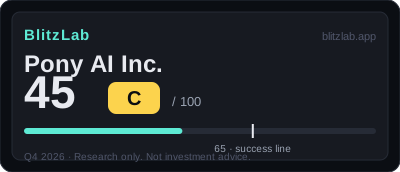
Pony AI Inc. — Blitz Index 45 (C)
Pony AI scores 45 — robotaxi fares up 849% with breakeven claimed in Guangzhou and Shenzhen, held back by a 17.5% gross margin and cash for four to five quarters at the current burn.
Last re-scored: August 18, 2026.
Confidence: Medium · Category: frontier
Score breakdown
| Section | Score | Detail |
|---|---|---|
| A · Speed | 20 / 25 | Robotaxi revenue +691%, fares +849%, Q1 +395% → Q2 +691% accelerating — speed of 80.0, matching WeRide |
| B · Moat | 24 / 60 | A large market (B3 9) and a second axis in robotrucks — but the lowest gross margin in the batch at 17.5% (B4 2): the moat is 40.0 against speed of 80.0 |
| C · Creative destruction | 11 / 15 | Robotaxis displacing human driving and ride-hailing — a real displacement, with breakeven claimed in Guangzhou and Shenzhen |
| D · BlitzFailing | −10 | Burn of ~$76M a quarter against $1.39B of cash — four to five quarters (D1 −4); dual-class founder control (D3 −2); city-permit and US–China risk (D4 −3) |
Think we scored it wrong? Score it yourself →
Radar axes (0–100): Moat 40.0 · Speed 80.0 · Creative 73.3.
Watch item
Gates: G1 ✓ (confirmed — robotaxi revenue +691%, fares +849%, plus a second axis in robotrucks at $13.3M, +40%) · G2 ✓ (estimated — the global robotaxi market of ~$415B by 2035 is 330× the bar). 20 points below the 65-point threshold — first score. No FLAG: deductions of 10, five points of headroom. Watch: whether the claimed city-level breakeven scales, whether the 3,500-vehicle year-end fleet target deepens the burn, and whether the cash lasts to the next raise.
Strengths
- Robotaxi explosion: +691% YoY, fares +849%, Q1 +395% → Q2 +691% accelerating
- Unit economics: breakeven claimed in Guangzhou and Shenzhen (management statement)
- Second axis: robotrucks at $13.3M (+40%), a Sinotrans collaboration, Gen-4 vehicles in commercial operation
- Fleet expansion: 2,000 vehicles toward a year-end target above 3,500, across 20 cities
- No bank borrowings: $0 of bank debt, cash of $1.39B
Concerns
- Lowest margin: a 17.5% gross margin and a −181.5% operating margin — the moat at 40.0 sits far below speed at 80.0
- Fast burn: ~$76M a quarter, four to five quarters of cash, capex up 3× year on year
- FY2025 base: annual growth of only +20% — the Q2 acceleration depends on the robotaxi ramp
- Regulation and geopolitics: city-by-city permits, US–China data and listing risk
- Governance: dual-class founder control (ratio unconfirmed)
Research notes
Thesis: the fastest ramp in robotaxis, on the thinnest margin
Pony AI enters the BlitzLab record with a first scoring of 45 out of 100, grade C, built from Speed 20 out of 25, Moat 24 out of 60, Creative Destruction 11 out of 15, and deductions of 10. The total sits 20 points below the 65-point line, and the shape of the score is the story: speed converts to 80.0 and creative destruction to 73.3, while the moat converts to only 40.0. This is the robotaxi company — trailing-twelve-month revenue of about $125.0 million — whose robotaxi revenue grew 691% year on year and whose fares grew 849%, accelerating from 395% in the first quarter, with breakeven claimed in Guangzhou and Shenzhen. The gross margin is 17.5%, the lowest in the batch, and the operating margin is −181.5%: the ramp is real and the economics are the thinnest in the batch.
What the business does
Pony AI is a pure-play Level 4 autonomous-driving company, listed on the Nasdaq and on the Hong Kong exchange, operating in China and the United States, and listed in November 2024. It earns revenue from three segments. Robotaxi is the headline: driverless ride-hailing, which brought in $12.1 million in the second quarter of 2026. Robotruck is the second axis: autonomous freight, at $13.3 million in the quarter, including a collaboration with Sinotrans and Gen-4 vehicles in commercial operation at Shenzhen's Mawan Port. Intelligent solutions, at $10.8 million, is licensing and project-based work — lumpier revenue that fell 18% year on year in the fourth quarter of 2025 on licensing timing alone. Total revenue in the second quarter was $36.2 million, and $125.0 million trailing.
The operating model is designed to share the capital burden of a fleet. Under the joint-deployment model, partners fund the vehicles and pay Pony AI service fees, so fleet expansion does not concentrate all the capital on Pony AI's own balance sheet. Original-equipment partners GAC, BAIC and Toyota supply Gen-7 models that are in daily operation, and the PonyWorld 2.0 world model, introduced in April 2026, is meant to let the company expand into new cities without adding engineering staff in proportion. The fleet stood at 2,000 vehicles at the end of June 2026, with a target of more than 3,500 vehicles and 20 cities by the end of 2026. The PonyPilot app had more than 1.5 million registered users in China by mid-August 2026, and management reports that unit economics have reached breakeven in Guangzhou and Shenzhen. Cash, short-term investments and related liquid instruments were $1.39 billion at 30 June 2026, down from $1.44 billion at the end of March, and the company had no bank borrowings at the end of 2025.
Why the score is what it is
Speed scores 20 out of 25 — the highest in the batch, and the whole story of the file. The A1 growth item scores 9 out of 10: second-quarter total revenue rose 68.8% year on year, robotaxi revenue rose 691.2%, accelerating from 395% in the first quarter, fare-charging revenue rose 849%, and first-half revenue rose 98.9%, with robotaxi up 534% over the half. The 9 rather than 10 reflects the base: trailing revenue is only $125 million, so the percentages carry a large base effect, and fiscal 2025 annual growth was only 20% — the acceleration depends entirely on the robotaxi ramp. Capital speed scores 4 out of 5: the cash pile of $1.39 billion and the demonstrated fundraising of the November 2024 IPO plus the Hong Kong listing are real, but the second quarter burned $44 million of operating cash plus $32.2 million of capital expenditure, and cash is falling by about $50 million a quarter. Hiring and productivity score 3 out of 5: the employee count is unconfirmed, so no hiring blitz can be evidenced, though revenue growing 69% against a much slower rise in the operating loss points the productivity direction the right way. Share speed scores 4 out of 5: the fleet, the user base and the two-city breakeven are evidence that share is actually moving — but no direct market-share figure is disclosed, and the position against Waymo and Apollo Go is unconfirmed.
The moat, at 24 out of 60, is the mirror image of the speed, and the gross margin is its weakest point. Network effects score 6 out of 18: fleet and driving data do accumulate and improve the PonyWorld model, and a larger user base raises vehicle utilisation — but users choose Pony.ai for availability, price and permits, not because other users are there, so it is a data and ecosystem effect rather than platform lock-in. Distribution scores 7 out of 18: the joint-deployment model is a genuine lever, and three Gen-7 models from GAC, BAIC and Toyota are running daily — but robotaxis still need city-by-city permits and fleet operations, so it is not fully product-led distribution, and the sales-and-marketing share is unconfirmed. Market size scores 9 out of 12, the best moat item: Goldman Sachs puts the global robotaxi market at about $415 billion by 2035 and the autonomous-vehicle sector at about $2 trillion, against a bar of $1.25 billion — trailing revenue is 0.03% of the 2035 market — though realisation depends on regulation, safety and public acceptance, and the addressable market is limited to permitted cities in China and overseas. Gross margin scores just 2 out of 12: the second-quarter gross margin was 17.5%, on gross profit of $6.4 million, up 83.4% year on year, and fiscal 2025 was 15.7% — a mixed margin with vehicle and hardware costs in it, and the lowest in the batch, two steps below WeRide's 4 points at a 37.5% gross margin. The operating margin was minus 181.5%, improved from minus 285.6%, but still deeply negative. Creative destruction scores 11 out of 15, the highest in the batch: human-driven taxis and ride-hailing give way to driverless robotaxis, and human-driven freight to robotrucks, with paid driverless rides now scaling — though the transition is an industry-wide push shared with Waymo, Apollo Go and WeRide rather than one Pony AI leads. The cost-structure item scores 3: Gen-7 model costs are reported down 60–70% in broker research, and the Guangzhou and Shenzhen breakeven is a real signal, but per-vehicle profit figures are undisclosed and the company still lost $45.4 million in the quarter.
The risks
Deductions total 10 points, and the largest is the cash clock. The D1 debt deduction of 4 points is not about leverage — there is none — but about burn: about $76 million a quarter, $44 million of operating cash outflow plus $32.2 million of capital expenditure, with first-half free cash outflow of $162.8 million. At that pace the $1.39 billion of cash is about four to five quarters of runway, and capital expenditure is already more than three times last year's pace, so hitting the year-end target of more than 3,500 vehicles will burn faster still. The D4 regulatory deduction of 3 points reflects dependence on autonomous-driving permits in each city in China and the United States — a delay or cancellation stops revenue — plus US–China geopolitics around the listing and data regulation of a Chinese ADS, and the industry characteristic that a single safety incident can halt a whole fleet. No open investigation or lawsuit was confirmed in the reviewed sources. Governance takes 2 points: a dual-class structure with Class B super-voting shares and founder control, with the voting split unconfirmed and minority voting structurally limited through the ADS structure. Revenue quality takes 1 point: intelligent solutions revenue is project-based and lumpy, and some robotaxi revenue is joint-deployment fees rather than pure fares.
What would change the score
The test is whether unit economics spread faster than the burn. If the fleet passes 3,500 vehicles across 20 cities by the end of 2026 and the breakeven claimed in Guangzhou and Shenzhen appears in more cities, the gross-margin item — currently 2 out of 12 — has room to move, and the speed score would be backed by economics rather than by percentages alone. The revenue guidance to watch is fiscal 2026 revenue of $162.3 million on the UOB estimate, with robotaxi revenue at more than 3.5 times 2025. The robotruck axis matters too: Sinotrans and the Gen-4 commercial operation at Mawan Port are the second engine, and its growth at 40% is steadier than the robotaxi ramp. The risk is the mirror image: if capital expenditure keeps tripling and the burn accelerates before unit economics spread, the four-to-five-quarter clock forces a refinancing before the economics are proven — and that is the single largest risk in the file.
The gates: both pass — the runway is four to five quarters
Gate 1, two pieces of product-market-fit evidence for a growth company, passes on a confirmed basis. Robotaxi revenue grew 691% and fares 849%, and the second axis — robotrucks at $13.3 million, up 40%, with a Sinotrans collaboration and Gen-4 vehicles in commercial operation — stands apart from robotaxis. Gate 2, a ten-year market ceiling at least ten times current revenue, passes as an estimate: the global robotaxi market of about $415 billion by 2035 is 330 times the bar. The fourth quarter of 2026 has not been reported at T, and its reporting date is unconfirmed — it is not a company-confirmed date and must not be presented as one — and no outcome is anticipated here. That is the balance of the record at T: the fastest robotaxi ramp in the batch, a fleet growing toward 3,500 vehicles, and about $76 million of quarterly burn against $1.39 billion of cash — four to five quarters, with capital expenditure already triple last year's pace.
More Frontier companies
Other Frontier names on the Blitz Index, highest score first: Rocket Lab (62/B), Tesla (62/B), Illumina, Inc. (61/B).
Next earnings
Nov 18, 2026 · Before open · Confirmed
Coverage
Pony AI Inc. · Next earnings unconfirmed at scoring · Score 45 · Grade C
Embed this score
Copy the HTML below to show this score on your site. The badge links back to this page and updates automatically when the score changes.
Preview:
BlitzLab scores businesses against a scholar’s standard — not investment advice. No price targets, no buy/sell recommendations. Figures are from SEC filings (XBRL) as labeled in the source scorecard.