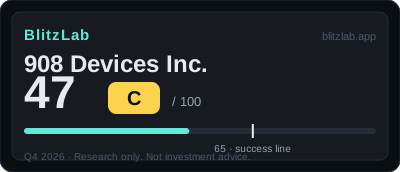
908 Devices Inc. — Blitz Index 47 (C)
908 Devices scores 47 — handheld mass spectrometry growing 23% after a $70M divestiture sharpened the focus, held back by an 87% operating loss and a sub-1% share against Thermo, Agilent, Waters and Bruker.
Last re-scored: August 11, 2026.
Confidence: Medium · Category: frontier
Score breakdown
| Section | Score | Detail |
|---|---|---|
| A · Speed | 16 / 25 | Continuing operations Q2 +23%, products +35.5%, installed base +23%, FY guidance raised to $68–70M — growth made visible by the $70M desktop divestiture |
| B · Moat | 25 / 60 | A niche lock in field workflows (B1 6) and government and defence channels (B2 6) with a 52% gross margin (B4 6) — but an 87% operating loss means no operating leverage yet |
| C · Creative destruction | 9 / 15 | Handheld mass spectrometry displacing lab-bound analysis at the point of need — a real displacement, in a market where the giants set the pace |
| D · BlitzFailing | −3 | Deductions of only 3 — the cleanest part of the score: cash of $63.0M plus divestiture proceeds, with only −1 on each of debt, quality and regulation |
Think we scored it wrong? Score it yourself →
Radar axes (0–100): Moat 41.7 · Speed 64.0 · Creative 60.0.
Watch item
Gates: G1 ✓ (confirmed — growth real: continuing operations +23% in Q2, products +35.5%, installed base +23%) · G2 ✓ (confirmed — the mass-spectrometry market at ~$12–15B by 2036, mobile alone ~$6.2B, against a $0.61B bar). 18 points below the 65-point threshold — first score. No FLAG: deductions of only 3. Watch: Q3 results (due 2026-11-10, after T), whether the handheld focus produces operating leverage, and whether share moves off sub-1% against the giants.
Strengths
- Growth accelerating: Q2 +23%, products +35.5%, installed base +23%, FY guidance raised (+21–25%)
- Focus after divestiture: the $70M desktop sale concentrates the business on handheld MX908 and bioprocessing MS
- Financial cushion: cash of $63.0M plus divestiture proceeds, total assets of $197.5M
- Market headroom: total MS of ~$12–15B by 2036, mobile alone ~$6.2B, against a $0.61B bar
- Gross margin stable: 50.6% (FY2025) → 51.9% (Q2 2026)
Concerns
- Operating loss: first-half operating loss of −$25.7M (−87% of revenue), net loss of −$23.8M — no operating leverage
- Weak moat: 41.7, with B1 and B2 both at 6 — no platform lock-in, high-cost sales dependence
- Giants in the market: under 1% share, with Thermo, Agilent, Waters and Bruker dominating
- Debt split and direct share unconfirmed — the limits on D1 and A4 precision
- Q3 results (2026-11-10) fall after T — the next rescore's observation point
Research notes
Thesis: the divestiture made the growth visible
908 Devices enters the BlitzLab record with a first scoring of 47 out of 100, grade C, built from Speed 16 out of 25, Moat 25 out of 60, Creative Destruction 9 out of 15, and deductions of 3. The total sits 18 points below the 65-point line, and the shape of the score is the story: speed converts to 64.0 and creative destruction to 60.0, while the moat converts to only 41.7. This is the handheld mass-spectrometry company — trailing-twelve-month revenue of about $60.8 million on a continuing-operations basis — that sold its desktop business for $70 million and emerged with a cleaner story: second-quarter growth of 23%, products up 35.5%, the installed base up 23%, guidance raised to $68–70 million. The $60.8 million is the clean post-sale baseline. What has not changed is the loss: a first-half operating loss of $25.7 million, 87% of revenue, with no operating leverage yet.
What the business does
908 Devices, based in Burlington, Massachusetts, makes handheld mass spectrometry instruments and bioprocessing mass spectrometry systems. Its flagship product is the MX908, a handheld device that identifies chemicals in the field — used by defence, emergency-response and forensic teams who need an answer on site rather than by sending a sample to a laboratory and waiting. The second line, bioprocessing mass spectrometry, monitors biopharmaceutical manufacturing processes. The company earns revenue from instruments, consumables, services and software, and the structure matters: every handheld device sold expands an installed base that then generates repeat revenue from consumables, service and software. That installed base grew 23% year on year in the second quarter of 2026, which is the mechanism by which a hardware sale becomes a recurring stream.
The business was deliberately narrowed in 2025. On 31 March 2025 the company sold its desktop portfolio — the MAVEN, REBEL and ZipChip products — to Repligen for $70 million, and that business is now presented as discontinued operations. What remains is the handheld MX908 and bioprocessing mass spectrometry. The sale is why the growth figures read as cleanly as they do: continuing-operations revenue was $56.2 million in fiscal 2025, up 17.7% year on year, and the trailing-twelve-month figure of about $60.8 million is the post-sale baseline, not a number flattered by a divested division. The $70 million also supplied the cash buffer the company now sits on. The team is small — 172 employees as reported in 2026 — which makes revenue per employee about $354,000 on trailing revenue, ordinary for a hardware-plus-field-sales business and far from a software ratio.
Why the score is what it is
Speed is the strongest axis, at 16 out of 25, and it is driven by the growth line. The A1 growth item scores 7 out of 10: second-quarter revenue rose 23.3% year on year to $16.07 million, product revenue rose 35.5%, and fiscal 2026 guidance was raised to $68–70 million, implying 21–25% growth. The 7 rather than a higher mark reflects two cautions in the file — first-quarter growth was only 13.5% on $13.38 million, and 2024 growth had flattened at 17.7%, so the acceleration is not yet proven durable. Capital speed scores 3 out of 5: cash of $63.0 million against total assets of $197.5 million and total liabilities of $70.8 million at 30 June 2026 is a real cushion, bought largely by the divestiture, but the first-half net loss of $23.8 million and operating loss of $25.7 million burn through it quickly, and the company has not demonstrated a large capital raise since listing. Hiring and productivity score 3 out of 5, and share speed 3 out of 5: the installed base is growing 23% inside its handheld niche, but no direct market-share figure is disclosed, and the company holds only about 0.8% of the total mass-spectrometry market.
The moat, at 25 out of 60, is the weak axis, and every item in it scores 6 or 7. Network effects score 6 out of 18: the MX908's chemical library and detection algorithms improve as usage data accumulates, and the device embeds itself in defence and emergency workflows, which creates switching costs — but that is a data and ecosystem effect, not the platform lock-in that would command a higher band. Distribution scores 6 out of 18: direct sales plus distribution partners reach government, defence and health channels, yet the model depends on expensive sales staff, and bioprocessing mass spectrometry needs a separate sales motion with limited channel synergy. Market size scores 7 out of 12: the gate passes comfortably on the total market, but the company's actual wedge is the handheld niche, and reaching the bar from 0.8% share requires a tenfold share expansion against incumbents. Gross margin scores 6 out of 12: the gross margin is stable in the low 50s — 51.7% in the first half of 2026, 51.9% in the second quarter, 50.6% in fiscal 2025 — but the operating margin in the first half was minus 87%, so there is gross margin without any operating leverage. Creative destruction scores 9 out of 15, three points on each item: handheld instruments replace the lab-bound order — send a sample, wait for the result — with instant analysis in the field, but they complement laboratory mass spectrometry rather than replacing it, and the behaviour change is industry-wide miniaturisation rather than something 908 Devices created alone.
The risks
Deductions are only 3 points, so no single risk dominates the file — the risk is the shape of the whole. The operating loss is the first: an 87% operating-loss margin on a 52% gross margin means sales and research spending consumes more than the gross profit the business makes, so growth widens the loss unless the cost structure changes. The second is the competitive position: Thermo Fisher, Agilent, Waters, Bruker and Danaher (SCIEX) dominate mass spectrometry, and the same giants are moving into the mobile area that is 908 Devices' wedge. The third is what is not yet known: the split of the $70.8 million of total liabilities is unconfirmed, a $15 million term loan tagged in 2022 filings does not appear in 2026 filings and its repayment is unconfirmed, and the direct market-share figure is undisclosed. The fourth is the government customer base: heavy defence and government exposure brings procurement, export-control and budget-cycle risk, even though no large litigation or enforcement issue was found. Third-quarter 2026 earnings, scheduled for 10 November 2026, fall after the scoring date of 11 August 2026 and are excluded from this record.
What would change the score
The next observation point is that third-quarter result, and what it would need to show is operating leverage, not just growth: sales and research costs growing more slowly than revenue, and the gross margin holding in the low 50s while the operating loss narrows. Confirmation of the debt split would remove a deduction uncertainty. On the commercial side, the score moves if the handheld device stops being a complement to the laboratory and becomes the field standard — installed-base growth sustained above 20% while the giants' mobile entries fail to take share — and if bioprocessing mass spectrometry becomes a second engine rather than a separate sales motion. The market ceiling is not the constraint; the company already passes the gate on the narrowest wedge. The constraint is whether focus, bought by selling the desktop business, produces leverage before the cash buffer thins.
The gates: both pass — the giants own the market around it
Gate 1, two pieces of product-market-fit evidence for a growth company, passes on a confirmed basis. Continuing-operations growth of 23% in the second quarter, products up 35.5% and the installed base up 23%, with guidance raised, is direct evidence. Gate 2, a ten-year market ceiling at least ten times current revenue, passes as a confirmed verdict: the mass-spectrometry market reaches roughly $12–15 billion by 2036, and the mobile wedge alone about $6.2 billion, against a bar of $0.61 billion. But the ceiling is not the capture: Thermo, Agilent, Waters and Bruker dominate the same market and 908 Devices holds under 1% of it. The fourth quarter of 2026 has not been reported at T, and its reporting date is unconfirmed — it is not a company-confirmed date and must not be presented as one — and no outcome is anticipated here. That is the balance of the record at T: a focused handheld business with a clean balance sheet and deductions of only 3, whose next test is whether focus produces leverage before the giants notice.
More Frontier companies
Other Frontier names on the Blitz Index, highest score first: Rocket Lab (62/B), Tesla (62/B), Illumina, Inc. (61/B).
Next earnings
Nov 10, 2026 · Before open · Confirmed
Coverage
908 Devices Inc. · Next earnings unconfirmed at scoring · Score 47 · Grade C
Embed this score
Copy the HTML below to show this score on your site. The badge links back to this page and updates automatically when the score changes.
Preview:
BlitzLab scores businesses against a scholar’s standard — not investment advice. No price targets, no buy/sell recommendations. Figures are from SEC filings (XBRL) as labeled in the source scorecard.