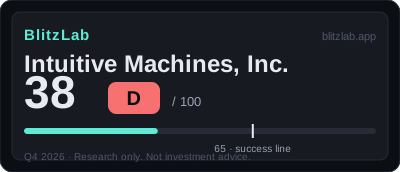
Intuitive Machines, Inc. — Blitz Index 38 (D)
Intuitive Machines scores 38 — six-month revenue up 248% on an acquisition, a $1.76 billion backlog and repeat NASA orders, held back by a DOJ investigation, a single customer at 78% of revenue, and the thinnest moat on the board.
Last re-scored: November 6, 2026.
Confidence: Medium · Category: frontier
Score breakdown
| Section | Score | Detail |
|---|---|---|
| A · Speed | 15 / 25 | Six-month revenue +248.2% YoY and Q2 +309.8%, but the growth is an acquisition: standalone FY2025 revenue fell −7.9% and Lanteris revenue is not separately disclosed, so organic growth cannot be measured |
| B · Moat | 21 / 60 | A $1.76B backlog and repeat NASA awards, but no network effect (B1 2 of 18) and a single customer at 78% of FY2025 revenue |
| C · Creative destruction | 10 / 15 | Commercial space infrastructure displacing the government monopoly — first commercial lunar landing, NASA buying landing as a service |
| D · BlitzFailing | −8 | DOJ False Claims Act investigation (active) plus a single customer at 78–90% and a pending Starlight lawsuit — 7 points from the FLAG line |
Think we scored it wrong? Score it yourself →
Radar axes (0–100): Moat 35.0 · Speed 60.0 · Creative 66.7.
Watch item
Gates: G1 ✓ (confirmed — backlog of $1.76B plus repeat NASA awards) · G2 ✓ (estimated — the diversified space-infrastructure market clears the bar at 0.24% of the 2035 space economy, though a lunar-lander-only market would likely fall short). 27 points below the 65-point threshold — the growth is explosive, but it was bought, and the moat is the thinnest on the board. Watch the DOJ investigation outcome, the Q3 2026 results, which were not yet filed at scoring, and whether FY2026 guidance of $900M–$1B is achieved.
Strengths
- Explosive reported growth: six-month revenue +248.2% YoY, Q2 +309.8%, FY2026 guidance $900M–$1B with positive adjusted EBITDA
- Backlog $1.76B (4.0 years of TTM revenue) plus RPO $814.7M — contracted future revenue
- First commercial lunar landing (IM-1, February 2024) plus NASA CLPS 4 awards, NSN sole awardee, LTV 1 of 3 primes, SDA PWSA — repeat-order evidence
- Margin improving: gross margin 4.3% in FY2025 → 16.8% in six months of 2026 (Q2 17.4%)
- Capital raising demonstrated: about $750M in ~12 months (convertible, offering, ATM), net cash $31.0M positive
Concerns
- Growth is acquisition-dependent: standalone FY2025 revenue fell −7.9%, organic growth cannot be separated [unconfirmed]
- DOJ False Claims Act investigation (active, 2023-10 CID → late-2025 violation claim) — the largest single deduction (D2 −4)
- Extreme customer concentration: a single customer at 78% of FY2025 revenue and 90% in FY2024 (name undisclosed)
- Deep losses: TTM operating loss $(119.4)M, six-month operating cash outflow $(111.9)M, FY2025 net loss $(106.8)M
- No network effect (B1 2 of 18) — contract- and project-based, no platform lock-in; Starlight lawsuit pending with summary judgment outstanding
Research notes
Thesis: explosive growth, bought not built
Intuitive Machines enters the BlitzLab record with a first scoring of 38 out of 100, grade D, built from Speed 15 out of 25, Moat 21 out of 60, Creative Destruction 10 out of 15, and deductions of 8. The total sits 27 points below the 65-point line, and the shape of the score is the story: on the radar conversion used by the model, Creative Destruction converts to 66.7, Speed to 60.0, and Moat to only 35.0 — the thinnest moat on the board. This is a space infrastructure company — trailing-twelve-month revenue of $437.7 million — whose reported growth is the fastest in the record and whose backlog has never been larger, yet whose growth was bought in an acquisition, whose largest customer is effectively one, and whose moat, measured on the frozen v1.0 anchors, is barely there. Both gates pass, so the scoring proceeds, but the second gate passes only as an estimate, on a diversified space-infrastructure market definition, and that qualification runs through everything that follows.
Growth: the numbers are real, the engine is acquired
Growth, A1, scores 5 out of 10, and the item captures a contradiction the file does not resolve. Revenue rose from $79.6 million in fiscal 2023 to $228.0 million in fiscal 2024, up 186.6%, then fell to $210.1 million in fiscal 2025, down 7.9%. The first six months of 2026 then exploded: revenue of $392.9 million, up 248.2% year on year, with the second quarter alone up 309.8%. Fiscal 2026 guidance, issued in August 2026, points to revenue of $900 million to $1 billion with positive adjusted EBITDA. The absolute trajectory is extraordinary — a company guiding to roughly four times its fiscal 2025 revenue in a single year. But the file is explicit about what the growth is: the 2026 surge is the Lanteris acquisition, completed on January 13, 2026, and Lanteris revenue is not separately disclosed, so organic growth cannot be measured. The standalone business shrank in fiscal 2025, and the file cannot say whether the underlying business is growing at all. That is what holds the item at 5: explosive reported growth and an unproven organic engine, scored in the middle.
The quality of that growth is where the file finds the margin story. Gross margin rose from 4.3% in fiscal 2025 ($9.0 million on $210.1 million of revenue) to 16.8% in the first six months of 2026 ($66.0 million on $392.9 million), reaching 17.4% in the second quarter. The direction is real, and the file credits it — B4 scores 5 out of 12. But the absolute level is low for a technology company, and the company is still deeply unprofitable: the trailing-twelve-month operating loss is $119.4 million, and the fiscal 2025 net loss was $106.8 million. Whether the margin improvement is operating leverage or an acquisition mix effect — Lanteris product revenue, which is now the largest revenue line at $308.3 million in six months against $78.8 million of services — cannot be separated. The growth-plus-margin-expansion signature is therefore incomplete: the growth is acquired, and the margin is still low.
The backlog is the visibility
The backlog is the strongest evidence in the file, and the score treats it as growth visibility rather than as growth itself. Contract backlog stood at $1.76 billion as of June 30, 2026, equal to about 4.0 years of trailing-twelve-month revenue, with remaining performance obligations of $814.7 million, about 1.9 years of revenue. The backlog surged from $213.1 million at December 31, 2025 — an eight-fold increase in six months — but the file is careful about what that surge is: it is the Lanteris acquisition effect, and the backlog is real contracted demand even if its growth is not organic. That order book is the evidence for two items at once: gate 1, where backlog plus repeat purchasing is one of the two qualifying proofs, and distribution scalability, B2, scored 6 out of 18, because the government-procurement position keeps converting into repeat awards. The file is careful, though, about what the backlog does not prove: it is a promise of future revenue, and its conversion depends on execution, on the customer paying, and on the contracts surviving the investigation described below.
From lander to infrastructure: the diversification
The diversification is the strategic claim of the file. Intuitive Machines is no longer only a lunar lander company. After the acquisitions, spacecraft manufacturing (Lanteris) is the largest revenue line — product revenue of $308.3 million in six months against $78.8 million of services — and the company now owns ground stations (Goonhilly) as well. The 10-K describes the addressable market as the full space value chain: ground stations and mission operations infrastructure, LEO and GEO and cislunar satellites, cislunar and lunar orbit communications and navigation, space stations, lunar landers, lunar surface infrastructure, space robotics, and deep-space missions beyond Mars. The company that landed Odysseus on the Moon in February 2024, the first commercial lunar landing, earning $132.4 million of contract revenue, now builds spacecraft, operates ground stations, and bids for satellite production. That diversification is what lets gate 2 pass: judged on the lunar-lander market alone, the company would likely fall short of the bar, and the file says so plainly.
Speed: fast capital, paid for in dilution
Speed scores 15 out of 25, and its four items show a company that raises capital fast and pays for it in shares. Capital velocity, A2, scores 4 out of 5: about $750 million raised in roughly twelve months — a $345.0 million convertible bond in August 2025 at 2.5% due 2030, a $175.0 million offering in February 2026 at $15.12 per share, and about $234.6 million through an at-the-market facility in the first six months of 2026. Capital is not the bottleneck. The item stops at 4 rather than 5 because the financing is external, not self-generated — six-month operating cash flow was an outflow of $111.9 million — and because the dilution is large: Class A shares outstanding rose from 121.3 million to 173.2 million in eight months, up 43%. Hiring and productivity, A3, scores 3 out of 5: trailing-twelve-month revenue of $437.7 million against about 1,695 employees implies revenue per employee of about $258,000, a middling figure, but the headcount itself jumped from 525 at December 31, 2025 to about 1,695 after the acquisition, so a hiring blitz cannot be evidenced — the expansion is an acquisition, not recruitment. Share-gain velocity, A4, scores 3 out of 5: the company's revenue is about 0.07% of the 2024 space economy of $613 billion, a negligible absolute share, but its growth rate far exceeds the market's 7 to 9%, so share gains can be inferred, though no directly measured market-share figure exists and the acquisition effect makes even the inference uncertain.
Moat: contracts, not networks
Moat scores 21 out of 60, the weakest section relative to its weight, and the file names the reason in its first item. Network effects, B1, score 2 out of 18. The business is contract- and project-based — NASA CLPS, NSN, LTV, SDA PWSA — so more users do not structurally raise the value for all users the way a platform does. What exists instead is a seed: the Connect element of the Build-Connect-Operate strategy — the NSN data-relay service, where the company is the sole awardee for lunar-orbit communications and navigation, and the Goonhilly ground-station network. But these are awards and infrastructure under construction, not an operating network, and the file scores them at the bottom of the weakest band. Distribution scalability, B2, scores 6 out of 18: government procurement is the distribution channel, and the competitive-bidding position plus relationships with NASA and the Space Development Agency produces repeat awards, evidenced by the $1.76 billion backlog. But the procurement cycle is long and the customer is effectively one government, so this is not viral or product-led distribution; it sits in the lower-middle of the repeatable paid-sales band. Market size, B3, scores 8 out of 12: the market is large — the space economy was $613 billion in 2024 and is projected at $1.8 trillion by 2035 — and the company's revenue is only about 0.07% of it, so the remaining room is large, but the addressable market is a subset of the broad space economy and the lunar-lander market alone is small, so the full mark is not given.
Creative destruction: commercial space displacing the government monopoly
Creative Destruction scores 10 out of 15, the strongest section on the radar, with all three items at 3 or 4 out of 5. The order being displaced, C1, scores 4 out of 5: the government monopoly on space exploration is being displaced by commercial space infrastructure — the first commercial lunar landing (IM-1, February 2024), and NASA procuring lunar landing as a commercial service through CLPS rather than building it itself. The order being displaced is clear and large. The item stops short of the full mark because the displacement is led by the commercial space industry as a whole, with SpaceX and other larger companies alongside, and Intuitive Machines participates as one company among several. Irreversible behavior change, C2, scores 3 out of 5: NASA's shift to commercial procurement (CLPS) is a structural change that is hard to reverse — once NASA buys landing as a service, it does not easily return to building landers itself. But this is a change in government procurement and policy, not a consumer behavior change of the kind the anchor describes at the top of the scale. Cost-structure change, C3, also scores 3 out of 5: commercial space lowers costs — a commercial lunar lander is cheaper than a government-built one, and the commercialization of spacecraft manufacturing and ground stations pushes industry costs down — yet no collapse in industry cost structure has been demonstrated, and the company's own margin of 16.8% does not prove it is a low-cost producer.
Deductions: an investigation, a single customer, and a lawsuit
Deductions total 8 points, so there is no FLAG: the FLAG line in the model sits at 15 points of deductions, leaving 7 points of headroom. Debt, D1, scores minus 2 out of a possible minus 10. Net cash is positive at $31.0 million — cash of $367.4 million against a convertible bond carrying value of $336.4 million. The convertible is $345.0 million of principal at 2.5%, unsecured, maturing October 1, 2030, with no near-term maturity. This is not distress. The deduction reflects the direction of travel: operating cash flow was an outflow of $111.9 million in six months, the company depends on equity dilution for capital, and the convertible's 2030 repayment or refinancing is a standing risk, alongside an Orbital Receivables Purchase Facility with a $250 million limit whose drawn balance was not disclosed. Revenue quality, D2, scores minus 4 — the largest single deduction in the file. The Department of Justice Civil Division issued a civil investigative demand to Lanteris in October 2023, alleging that Lanteris submitted false claims to the federal government while failing to meet federal cybersecurity requirements for government contracts. By late 2025 the Department presented its initial findings and alleged specific False Claims Act violations on certain federal government contracts. Lanteris is cooperating, and the seller's parent (Vantor Holdings) agreed to indemnify, but the outcome and the monetary scale were not disclosed. A false-claims allegation goes directly to the substance of revenue. The same item carries the second charge: extreme customer concentration, with a single customer at 78% of fiscal 2025 revenue and 90% in fiscal 2024 (the customer's name is not disclosed — whether it is NASA is unconfirmed). From the second quarter of 2026 the revenue spread across four customers (35%, 28%, 11%, 10%), but on the fiscal 2025 basis the company depended on effectively one customer. Governance, D3, scores 0: no dual-class voting, founder voting concentration, or private-equity sponsor control was disclosed, though the capital structure is complex (an UP-C structure with Class A and C common stock and Series A preferred stock). Regulatory and social cost, D4, scores minus 2: the Starlight lawsuit, filed in Delaware Chancery in November 2024, claims unspecified contract damages and equitable relief, with a summary-judgment application pending since February 2026 and no reserve (the loss is not judged both probable and reasonably estimable). The DOJ investigation's regulatory dimension is recorded here at a minimum to avoid double-counting with D2. No material securities class action or SEC investigation was disclosed. The IM-2 landing anomaly of March 2025 was a mission failure, not a human accident.
The gates: both pass — and the second pass is an estimate
Gate 1, product-market fit for an early-stage and growth company, passes on a confirmed basis. Two of the four proofs are met: the backlog of $1.76 billion, about 4.0 years of trailing-twelve-month revenue, and repeat purchasing from NASA — four CLPS lunar-delivery awards, the NSN near-space network (awardee in two of two areas plus sole awardee for data-relay service 2.2), one of three primes on the Lunar Terrain Vehicle, and SDA PWSA Tranche 1, 2, and 3 satellite-production support. The IM-1 landing is supporting evidence that the product works. Organic growth is not evidenced — standalone fiscal 2025 revenue fell 7.9% and Lanteris revenue is not separately disclosed — but gate 1 needs only two of four. Gate 2, a ten-year market ceiling at least ten times current revenue, also passes, but the file declares its market definition before doing the arithmetic and marks the verdict as an estimate. Revenue is total GAAP revenue, since the company has no pass-through fee character that would require a contribution-profit normalization. The bar is about $4.38 billion, ten times trailing-twelve-month revenue of $437.7 million. The addressable market is the diversified space-infrastructure market — spacecraft manufacturing, ground stations and data services, cislunar and lunar services — consistent with the 10-K's description of the full space value chain. The only quantified market data in the file is the broad space economy: $613 billion in 2024 (Space Foundation, up 7.8%) growing to a projected $1.8 trillion by 2035 (World Economic Forum and McKinsey, about 9% a year). The bar is about 1/140th of the 2024 space economy and about 1/411th of the 2035 projection; reaching the bar requires only about 0.24% of the 2035 space economy, a share gain of about 3.4 times from today's 0.07%. Even if only 10% of the space economy were addressable ($61 billion today), that market would be about 14 times the bar. The sensitivity the file records matters as much as the pass: judged on the lunar-lander market alone, the company would likely fall short of the bar — the standalone lunar-economy figure is not in the file — so the gate pass depends on the diversified definition rather than on the company's flagship sub-market. The backlog of $1.76 billion and fiscal 2026 guidance of $900 million to $1 billion support the reality of market demand, but the verdict is an estimate because the market definition is uncertain.
Blitzscaling fit: the government-procurement blitzer
The blitzscaling-fit analysis gives Intuitive Machines a label the file states plainly: the government-procurement blitzer. The main levers are product, meaning spacecraft and lunar landers, and distribution, meaning government procurement; the secondary lever is the platform character of the Connect strategy — NSN and the ground-station network; the weak lever is network effects. The speed-versus-efficiency trade was made in favor of speed: revenue grew 248% in six months while the operating loss widened to $119.4 million on a trailing basis, the classic blitz pattern of sacrificing profitability for growth — except that the growth was bought in an acquisition rather than won in the market. That is the behavior of a company that is blitzing on someone else's revenue. The file's judgment is that Intuitive Machines is an early-stage company whose blitz is real in its reported numbers and unproven in its organic engine, with the backlog, the NASA relationship, and the $900 million to $1 billion guidance as the platform for it. The single largest blitzscaling risk is stated as one line: the government as the single customer, under investigation. If the DOJ investigation produces a finding, if procurement is delayed, or if a rival wins the next round, growth, orders, and the backlog move together — and the backlog, large as it is, consists of government contracts that are not free of budget, administration, and now legal risk.
What to watch
What to watch follows directly from the score. The first is the DOJ investigation outcome: whether the False Claims Act allegation produces a finding, a settlement, or a clearance, and at what monetary scale — the file records the outcome and the scale as unconfirmed, and either would move the largest deduction in the file. The second is the third-quarter 2026 results, which had not been filed at the scoring date and were excluded from this assessment; they will show whether the growth trajectory holds and whether the Lanteris and Goonhilly purchase accounting is complete. The third is fiscal 2026 guidance: whether revenue of $900 million to $1 billion and positive adjusted EBITDA are achieved, and whether the growth is organic or still acquired. The fourth is customer diversification: whether the four-customer spread visible in the second quarter of 2026 (35%, 28%, 11%, 10%) holds and deepens, or whether the fiscal 2025 concentration reasserts itself. The fifth is the moat: whether the NSN sole award and the Goonhilly ground-station network become an operating network with lock-in, or remain awards and infrastructure under construction. A future rescoring will have new figures for revenue, backlog, margins, and cash flow, and the honest test of this 38-point assessment is whether those figures move the items that currently keep it down: the acquisition-dependent growth, the investigation and concentration that cap revenue quality, and the network effect that is barely there.
More Frontier companies
Other Frontier names on the Blitz Index, highest score first: Rocket Lab (62/B), Tesla (62/B), Illumina, Inc. (61/B).
Next earnings
Nov 12, 2026 · Before open · Confirmed
Coverage
Intuitive Machines, Inc. · Next earnings unconfirmed at scoring · Score 38 · Grade D
Embed this score
Copy the HTML below to show this score on your site. The badge links back to this page and updates automatically when the score changes.
Preview:
BlitzLab scores businesses against a scholar’s standard — not investment advice. No price targets, no buy/sell recommendations. Figures are from SEC filings (XBRL) as labeled in the source scorecard.