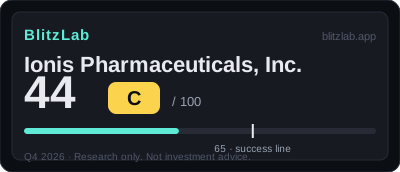
Ionis Pharmaceuticals, Inc. — Blitz Index 44 (C)
Ionis scores 44 — a 30-year antisense platform with commercial revenue up 49%, held back by a TRYNGOLZA ramp cut in half, structural operating losses, and a pipeline miss.
Last re-scored: November 9, 2026.
Confidence: Medium · Category: frontier
Score breakdown
| Section | Score | Detail |
|---|---|---|
| A · Speed | 16 / 25 | Headline Q3 +55% is an ex-one-off figure; the real engine is commercial revenue, +49% in FY2025 — but the TRYNGOLZA launch ramp was cut roughly in half |
| B · Moat | 26 / 60 | A 30-year antisense platform (B1 7) and an RNA market worth reaching (B3 8) — but no margin-expansion signature (B4 4), and pipeline failures narrow the platform's reach |
| C · Creative destruction | 10 / 15 | Antisense RNA medicines displacing chronic-dosing and non-targeted therapy across rare and cardiometabolic disease — a real substitution, paced by clinical readouts |
| D · BlitzFailing | −8 | Convertibles of ~$1.75B plus $551M of royalty-sale debt and $262M of leases (D1 −3); one-off-dependent revenue quality (D2 −3); pipeline and market-definition risk (D4 −2) |
Think we scored it wrong? Score it yourself →
Radar axes (0–100): Moat 43.3 · Speed 64.0 · Creative 66.7.
Watch item
Gates: G1 ✓ (confirmed — commercial revenue +49% in FY2025, SPINRAZA global sales +23% in Q3, plus a second curve in DAWNZERA and ZANVASTRO) · G2 ✓ (estimated — the RNA therapeutics market extrapolates to ~$40–51B by 2036, 4–5× the bar, though the narrowest definition falls short). 21 points below the 65-point threshold — first score. No FLAG: deductions of 8. Watch: whether TRYNGOLZA recovers its ramp, whether the non-GAAP operating loss guidance of −$425–475M narrows, and whether the next Phase 3 readouts land.
Strengths
- Commercial revenue growing: FY2025 +49% ($436M), Q4 +64%, SPINRAZA global sales of $461M in Q3 (+23%)
- Second growth curve showing: DAWNZERA launch momentum (Europe, Canada), ZANVASTRO's first independent launch, two Phase 3 trials hitting primary endpoints
- Cash of $1.9B, year-end guidance above $1.6B — more than three years of cover
- Convertible maturity ladder cleaned up: a 2030 issue retired the 2026 notes, coupons at 0–1.75%
- A large market: RNA therapeutics extrapolate to ~$40–51B by 2036, 4–5× the bar
Concerns
- One-off dependence: $280M of FY2025 revenue was a sapablursen licence fee, and R&D collaboration revenue is volatile
- TRYNGOLZA ramp slowing: guidance cut roughly in half ($100–110M → ~$50M)
- Structural operating losses: GAAP Q3 −$130M, non-GAAP FY2026 guidance of −$425–475M
- Pipeline failure: eplontersen missed its primary endpoint in CARDIO-TTRansform
- Debt stack: convertibles of ~$1.75B plus $551M of royalty-sale debt and $262M of leases
Research notes
Thesis: the growth is real once the one-offs are stripped out
Ionis Pharmaceuticals enters the BlitzLab record with a first scoring of 44 out of 100, grade C, built from Speed 16 out of 25, Moat 26 out of 60, Creative Destruction 10 out of 15, and deductions of 8. The total sits 21 points below the 65-point line, and the shape of the score is the story: creative destruction converts to 66.7 and speed to 64.0, while the moat converts to only 43.3. This is the antisense RNA company — trailing-twelve-month revenue of about $960 million — whose headline growth of 55% in the third quarter needs unwrapping: $280 million of fiscal 2025 revenue was a one-off licence fee, and the real engine is commercial revenue, up 49% in fiscal 2025 on SPINRAZA and the new launches. That engine has just cracked: the TRYNGOLZA launch ramp was cut roughly in half, from $100–110 million of guidance to about $50 million.
What the business does
Ionis Pharmaceuticals is an antisense RNA therapeutics company built on more than thirty years of antisense oligonucleotide chemistry — a platform from which many drugs are designed and manufactured. It sells medicines for rare and genetic diseases, and its revenue comes in three forms that behave very differently. Product sales were $48 million in the third quarter of 2026 and $122 million in the first nine months: TRYNGOLZA for severe hypertriglyceridaemia, at $9 million in the quarter and $41 million over nine months; DAWNZERA for hereditary angioedema, at $37 million in the quarter and $79 million over nine months; and ZANVASTRO, at $2 million in its first quarter. Royalties are the second form: SPINRAZA, the spinal muscular atrophy drug sold by partner Biogen, generated $461 million of global sales in the quarter, up 23% year on year, paying Ionis a $69 million royalty, and WAINUA, the ATTR drug sold by AstraZeneca, generated $68 million globally and a $7 million royalty. The third form is research and development collaboration revenue from partners, which is lumpy and partner-dependent. Chronic dosing is the commercial logic: patients take these medicines for life, so each prescription is repeat revenue.
The scale is close to a billion dollars: trailing total revenue is about $960 million — the fourth quarter of 2025 at $203 million plus the first nine months of 2026 at $757 million — against $705 million in fiscal 2024 and $944 million in fiscal 2025. But the fiscal 2025 figure contains a $280 million one-off sapablursen licence fee, which is why the headline growth rate of 34% overstates the underlying business. Stripping that out, the third quarter grew 55% year on year and the first nine months 64%, and fiscal 2026 guidance of $875–900 million is a headline decline against fiscal 2025 but about 20% growth on the one-off-excluded basis. Commercial revenue — products plus royalties — was $436 million in fiscal 2025, up 49% year on year. The company held cash and short-term investments of $1.9 billion at 30 September 2026, down from $2.68 billion at the end of 2025, with year-end cash guidance of $1.6 billion or more. The chief executive is Brett Monia, and the commercial team was expanded by about 200 field staff to support the TRYNGOLZA launch.
Why the score is what it is
Speed scores 16 out of 25. The A1 growth item scores 7 out of 10: the one-off-excluded growth rates of 55% in the quarter and 64% over nine months are strong, but three cautions hold the item back — the $280 million licence fee inside fiscal 2025, the headline guidance decline for fiscal 2026, and the TRYNGOLZA guidance cut from $100–110 million to about $50 million, roughly half. Capital speed scores 4 out of 5: the $1.9 billion cash position covers more than three years, and a fourth-quarter 2025 convertible refinancing tidied the maturity structure — a 2030 zero-coupon issue funding the repayment of the 2026 notes of $432 million — but the company depends on that cash pile rather than self-generated cash flow, with a non-GAAP operating-loss guidance of minus $425–475 million for fiscal 2026. Hiring and productivity score just 2 out of 5: the 2026 headcount is undisclosed, so revenue per employee cannot be computed, and no hiring blitz can be evidenced, though the 200-person field expansion is confirmed. Share speed scores 3 out of 5: the evidence points in both directions — SPINRAZA global sales up 23% and DAWNZERA's launch momentum with further launches in Europe and Canada are positive, but the TRYNGOLZA ramp is slower than expected and the eplontersen CARDIO-TTRansform trial missed its primary endpoint in the third quarter, and no direct market-share figure is disclosed.
The moat, at 26 out of 60, is the weak axis. Network effects score 7 out of 18: the thirty-year platform — accumulated oligonucleotide design and manufacturing know-how, and a pipeline built on it — is a genuine ecosystem, and chronic patients face high switching costs because stopping treatment lets the disease progress — but it is not platform lock-in or two-sided liquidity, and Alnylam competes on the same ceiling. Distribution scores 7 out of 18: an owned commercial team of about 200 field staff plus partner distribution through Biogen, AstraZeneca and Roche, with the independent launches of DAWNZERA and ZANVASTRO demonstrating the capability — but distribution depends on expensive sales staff, and operating costs exceed revenue. Market size scores 8 out of 12: on the Grand View and MarketsandMarkets definitions, the RNA therapeutics market reaches about $40–51 billion by 2036, four to five times the bar of $9.60 billion, growing at about 19% a year — but the narrowest vendor definition, TBRC at about $7.3 billion by 2036, falls short of the bar, and pipeline failures limit which parts of the market Ionis can reach. Gross margin scores 4 out of 12: the drugs themselves carry high gross margins, but the exact GAAP gross margin is undisclosed, and at company level there is no operating leverage — the GAAP operating loss was minus $130 million in the third quarter, 53% of revenue, and minus $382 million in fiscal 2025, so growth is accelerating while the operating loss widens. Creative destruction scores 10 out of 15: symptomatic and small-molecule treatment of rare genetic disease is giving way to RNA-targeted therapy aimed at the causal gene, and SPINRAZA, WAINUA and DAWNZERA have each changed the treatment paradigm in their indication — though the shift is an industry-wide one shared with Alnylam, and Ionis is one participant in it, and the new paradigm takes time to establish, as the TRYNGOLZA ramp shows.
The risks
Deductions total 8 points, split between the balance sheet and revenue quality. The D1 debt deduction of 3 points reflects a convertible stack of about $1.75 billion — the 2026 notes of $432 million due for repayment, the 2028 notes of $568 million at 1.75%, and the 2030 notes of $751 million at 0% — against cash of $1.9 billion, plus $551 million of debt related to a future royalty sale and $262 million of long-term leases, leaving estimated net debt of about $0.4 billion. The maturities are spread and the coupons are low, which keeps the deduction at 3 rather than higher. The D2 revenue-quality deduction of 3 points reflects the one-off problem: $280 million of fiscal 2025's $944 million was the sapablursen licence fee, collaboration revenue is volatile and partner-dependent, and the TRYNGOLZA guidance cut in half damages the credibility of the commercial outlook. The D4 regulatory deduction of 2 points reflects the structural pricing and reimbursement pressure on high-priced rare-disease therapies, the eplontersen CARDIO-TTRansform primary-endpoint miss — pipeline value damaged, though not a regulatory sanction — and the approval and labelling risk that is every new drug's premise. No fines, sanctions or product-safety events were confirmed in the reviewed sources. Governance takes none: no dual-class, founder or sponsor control issue was found, though major shareholders and board composition are unconfirmed. One more honesty note from the file: the gate's pass depends on the market definition — on the narrowest vendor definition it fails, and Ionis would need about 24% of the 2036 Grand View market to reach the bar on total revenue.
What would change the score
The second curve is already in motion, and the next quarters test whether it carries the score. DAWNZERA's launch momentum, with further launches in Europe and Canada, has fiscal 2026 guidance of $110–120 million maintained; ZANVASTRO's first independent launch, with the first patient starting commercial treatment, is the newest engine; and the Phase 3 primary endpoints met for sefaxersen and ulefnersen are the pipeline's next conversion points. The score moves up if the TRYNGOLZA ramp recovers toward its original guidance, if DAWNZERA hits its $110–120 million, and if the operating loss narrows from the guided minus $425–475 million — the margin item, currently 4 out of 12, is the clearest upside. It moves down if the pattern repeats: another pipeline failure like the eplontersen heart trial, or another launch ramp cut in half, would hit the share-speed item and the revenue-quality deduction together, while the operating loss keeps drawing down a cash pile that fell from $2.68 billion to $1.9 billion in nine months.
The gates: both pass — the second depends on the market definition
Gate 1, two pieces of product-market-fit evidence for a growth company, passes on a confirmed basis. Commercial revenue grew 49% in fiscal 2025, SPINRAZA global sales rose 23% in the third quarter, and the second curve is showing in DAWNZERA's launch momentum and ZANVASTRO's first independent launch. Gate 2, a ten-year market ceiling at least ten times current revenue, passes as an estimate: the RNA therapeutics market extrapolates to roughly $40–51 billion by 2036, four to five times the bar — though the narrowest vendor definition falls short of the bar, so the pass depends on the definition chosen. The fourth quarter of 2026 has not been reported at T, and its reporting date is unconfirmed — it is not a company-confirmed date and must not be presented as one — and no outcome is anticipated here. That is the balance of the record at T: a platform with thirty years of chemistry behind it, cash for three years, and a commercial engine whose newest launch is already slowing.
More Frontier companies
Other Frontier names on the Blitz Index, highest score first: Rocket Lab (62/B), Tesla (62/B), Illumina, Inc. (61/B).
Next earnings
Q4 2026 · Expected
Coverage
Ionis Pharmaceuticals, Inc. · Next earnings unconfirmed at scoring · Score 44 · Grade C
Embed this score
Copy the HTML below to show this score on your site. The badge links back to this page and updates automatically when the score changes.
Preview:
BlitzLab scores businesses against a scholar’s standard — not investment advice. No price targets, no buy/sell recommendations. Figures are from SEC filings (XBRL) as labeled in the source scorecard.