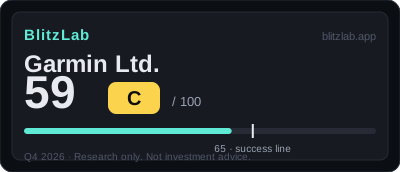
Garmin Ltd. — Blitz Index 59 (C)
Garmin scores 59 — wearables and avionics growing 12.5% with a 61% gross margin and deductions of just 1 point, held back by a creative-destruction score of only 8: a premium product, not a displacement.
Last re-scored: October 28, 2026.
Confidence: High · Category: consumer
Score breakdown
| Section | Score | Detail |
|---|---|---|
| A · Speed | 19 / 25 | FY2024 +20.4% → FY2025 +15.1% → nine months +12.5%, Q3 +12.2% on unit sales +9% — solid growth, on a decelerating trajectory |
| B · Moat | 33 / 60 | The sturdiest moat in its batch: a wearable ecosystem (B1 7), global distribution (B2 8), a large market (B3 9) and a high margin (B4 9) — all four B items at 7 or above |
| C · Creative destruction | 8 / 15 | Premium-product expansion rather than displacement: the weakest creative destruction in its batch, and the structural cap on the score |
| D · BlitzFailing | −1 | Deductions of a single point — the lowest in its batch: debt-free, clean revenue, single-class stock, only tariff and trade exposure (D4 −1) |
Think we scored it wrong? Score it yourself →
Radar axes (0–100): Moat 55.0 · Speed 76.0 · Creative 53.3.
Watch item
Gates: G1 ✓ (confirmed — growth sustained: FY2024 +20.4%, FY2025 +15.1%, nine months +12.5%, four segments growing at once) · G2 ✓ (confirmed — wearables extrapolate to ~$332–522B by 2036, 4.2–6.6× the bar). 6 points below the 65-point threshold — first score. No FLAG: deductions of 1, the furthest profile from the line. Watch: whether the growth deceleration (20.4% → 15.1% → 12.5%) flattens, and whether Auto OEM's −20% keeps dragging the total.
Strengths
- Steady growth: FY2024 +20.4% → FY2025 +15.1% → nine months +12.5%, Q3 +12.2%, unit sales +9%
- Four segments growing at once: Fitness +16%, Outdoor +20%, Marine +16%, Aviation +5% (Q3)
- High margins: TTM gross margin of 61.1%, operating margin of 28.8% (nine months) and 30.8% (Q3)
- Debt-free with $4,066.6M of liquidity (~52% of TTM revenue) and nine-month operating cash flow of $1,333.4M
- Diversified: five segments, no single customer above 10%
Concerns
- Growth decelerating: 20.4% → 15.1% → 12.5%
- Auto OEM at −20% (domain-controller decline) — the only shrinking segment, dragging the total
- Weak creative destruction: C at 8 — premium-product expansion rather than a displacement story (C1 3, C2 3, C3 2)
- Tariff and trade risk: APAC manufacturing exposure (D4 −1)
- Six points short of the 65 line — the structural cap on C is what holds the score back
Research notes
Thesis: the cleanest profile in its batch — and a structural ceiling
Garmin enters the BlitzLab record with a first scoring of 59 out of 100, grade C, built from Speed 19 out of 25, Moat 33 out of 60, Creative Destruction 8 out of 15, and deductions of 1. The total sits 6 points below the 65-point line, and the shape of the score is the story: speed converts to 76.0 and the moat to 55.0, while creative destruction converts to only 53.3. This is the wearables, outdoor, marine and aviation company — trailing-twelve-month revenue of about $7,887 million — with the sturdiest moat in its batch (all four moat items at 7 or above), a 61.1% gross margin, $4,066.6 million of liquidity, and deductions of a single point, the lowest in its batch. What holds it back is not quality but kind: Garmin extends premium products rather than displacing an order, and creative destruction at 8 of 15 is the structural cap.
The gates: both pass — the deceleration is the watch item
Gate 1, sustained growth or a second growth curve for a mature company, passes on a confirmed basis. Revenue grew 20.4% in fiscal 2024, 15.1% in fiscal 2025 and 12.5% in nine months, with four segments growing at once in the third quarter — Fitness +16%, Outdoor +20%, Marine +16%, Aviation +5% — and only Auto OEM shrinking, at −20%. Gate 2, a ten-year market ceiling at least ten times current revenue, passes as a confirmed verdict: wearables extrapolate to roughly $332–522 billion by 2036, 4.2 to 6.6 times the bar. The fourth quarter of 2026 has not been reported at T, and its reporting date is unconfirmed — it is not a company-confirmed date and must not be presented as one — and no outcome is anticipated here. That is the balance of the record at T: the furthest profile from the FLAG line, six points from the 65 line, and a growth rate decelerating from 20.4% to 12.5% — the question is whether the deceleration flattens before the score's ceiling binds.
The business: five hardware segments, one wearables engine
Garmin sells premium hardware across five segments, and the wearables engine now carries the company. Fitness and Outdoor together are about 65% of revenue; in the third quarter Fitness brought $694.3 million, up 16%, Outdoor $597.3 million, up 20%, Marine $309.9 million, up 16%, and Aviation $252.7 million, up 5%, while Auto OEM fell 20% to $131.9 million. Revenue ran from $5,228.3 million in fiscal 2023 to $7,245.5 million in fiscal 2025, up 15.1%, to $5,761.7 million in the first nine months of 2026, up 12.5% year on year. Unit sales rose 9% in the quarter, 5,440 thousand against 4,982 thousand. The recurring axis is Garmin Connect and the health and fitness subscriptions that turn a hardware sale into repeat revenue. Trailing revenue is about $7,887 million.
Why it scored 59: the sturdiest moat in its batch, capped by creative destruction
Speed scores 19 of 25. Growth (A1, 7 of 10) is solid for a mature company, but the trajectory is decelerating — 20.4%, then 15.1%, then 12.5% — and the single shrinking segment, Auto OEM at minus 20%, drags the total. Capital speed (A2, 4 of 5) is self-generated: operating cash flow of $1,333.4 million in nine months, up 23.5% year on year, cash of $2,039.8 million plus securities of $2,026.8 million for total liquidity of $4,066.6 million, and long-term debt of zero. Hiring (A3, 4 of 5) shows revenue growing faster than headcount — about 23,000 employees, up 5.5% year on year at the end of 2025, against revenue up 12.5%, for trailing revenue per employee of about $343,000. Share speed (A4, 4 of 5) is indirect but consistent: Fitness up 16% and Outdoor up 20% beat market growth of about 12–15%, but no direct share figure is disclosed.
The moat scores 33 of 60, and it is the most even moat in its batch — all four items at 7 or above. Network effects (B1, 7 of 18) are ecosystem and data effects rather than platform lock: device, app, health data and subscription are bundled in Garmin Connect, and a user's accumulated workout and health data raises the cost of switching. Distribution (B2, 8 of 18) is multi-layered and global: direct sales, retail and specialty stores worldwide, and aviation and marine business-to-business and business-to-government channels. Market size (B3, 9 of 12) is ample: wearables extrapolate to about $332–522 billion by 2036, 4.2 to 6.6 times the bar of $78.87 billion, while trailing revenue is only about 7–9% of the market. Gross margin (B4, 9 of 12) is unusually high for a hardware company: a trailing gross margin of 61.1% and an operating margin of 28.8% over nine months — stable rather than expanding, which is why the item stops at 9.
Creative destruction scores 8 of 15, the lowest conversion in the profile at 53.3, and it is the structural cap on the score. What is being displaced (C1, 3 of 5) exists but is limited: traditional watches and fitness trackers giving way to smartwatches and health wearables, paper maps and standalone navigation giving way to integrated navigation. The stronger description of the business is premium products extending into existing markets — outdoor, aviation, marine — rather than a company displacing an order. The behaviour change (C2, 3 of 5) is close to irreversible — daily tracking of exercise, sleep and health is a habit users do not readily give up — but the change belongs to the whole market, Apple and Samsung and Garmin together, not to Garmin alone. The cost-structure change (C3, 2 of 5) is the weakest item: Garmin products can lower a user's health-management costs, but neither effect reaches the level of an industry cost structure being changed.
The risks: one point of deductions — the cleanest profile in its batch
The deductions total 1, the lowest in the batch and the furthest profile from the FLAG line. Debt (D1, 0) is a non-issue: long-term debt is zero and total liquidity of $4,066.6 million is about 52% of trailing revenue. Revenue quality (D2, 0) is clean: no restatement or auditor issue, no customer concentration risk, five segments spreading the revenue, and no single customer above 10% of revenue. Governance (D3, 0) is a single class of stock with no founder control: the largest holder, Min H. Kao, holds 9.7%, and officers, directors and family together hold about 15%. The single point is regulation (D4, minus 1): a substantial share of manufacturing sits in Asia-Pacific, in Taiwan and China, leaving tariff and trade-policy exposure, and health-data collection carries regulation under GDPR, CCPA and equivalents, although no material investigation is confirmed.
What would change the score
Garmin is six points below the 65 line, and the gap is not a quality problem — it is a kind problem. The deductions cannot fall further in any meaningful way, so the score rises only if the moat or the creative destruction axis moves. The most plausible path is Fitness and Outdoor continuing to outgrow a wearables market growing at about 12–15%, with the subscription layer deepening the ecosystem lock that currently scores 7. A recovery in Auto OEM would remove the one shrinking segment. The risk runs the other way too: growth has decelerated from 20.4% to 15.1% to 12.5%, and if the wearables market matures, Garmin's growth converges on the market rate.
More Consumer companies
Other Consumer names on the Blitz Index, highest score first: e.l.f. Beauty, Inc. (58/C), On Holding AG (57/C), Hims & Hers (49/C).
Next earnings
Q4 2026 · Expected
Coverage
Garmin Ltd. · Next earnings unconfirmed at scoring · Score 59 · Grade C
Embed this score
Copy the HTML below to show this score on your site. The badge links back to this page and updates automatically when the score changes.
Preview:
BlitzLab scores businesses against a scholar’s standard — not investment advice. No price targets, no buy/sell recommendations. Figures are from SEC filings (XBRL) as labeled in the source scorecard.