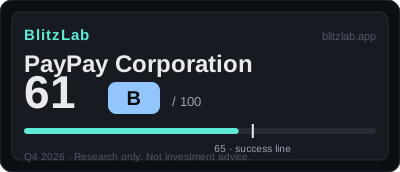
PayPay Corporation — Blitz Index 61 (B)
PayPay scores 61 — ~75M registered users, three straight years of 27% growth and a 36% EBITDA margin, held back by SoftBank's 91.78% of the votes and a market that is one country.
Last re-scored: November 4, 2026.
Confidence: Medium · Category: platforms
Score breakdown
| Section | Score | Detail |
|---|---|---|
| A · Speed | 19 / 25 | Three straight years of 27%-range growth, Q2 +27.7%, FY2026 guidance raised to ¥474–478B — steady rather than accelerating, at 27% |
| B · Moat | 41 / 60 | The strongest moat in its batch: network dominance (B1 11) plus distribution (B2 12) plus market (B3 9) plus margin (B4 9) — ~75M users, 60% of the population |
| C · Creative destruction | 11 / 15 | QR and cashless payments displacing cash across Japan, with financial services as the second displacement — a real substitution, in one country |
| D · BlitzFailing | −10 | SoftBank-controlled entities hold 91.78% of votes in a controlled company (D3 −4); extensive related-party transactions (D2 −2); rate-sensitive bank-style leverage (D1 −2) |
Think we scored it wrong? Score it yourself →
Radar axes (0–100): Moat 68.3 · Speed 76.0 · Creative 73.3.
Watch item
Gates: G1 ✓ (confirmed — growth sustained: three straight years at ~27% plus a second curve in financial services, +38% YoY) · G2 ✓ (estimated — the payments take-rate pool alone is only ~1.2× the bar at 100% share; the headroom depends on financial services). 4 points below the 65-point threshold — first score. No FLAG: deductions of 10, five points of headroom. Watch: whether financial services keep outgrowing payments, whether the take rate keeps rising (1.64% → 1.74%), and whether the single-country market caps the score.
Strengths
- Durable growth: three straight years at ~27%, Q2 +27.7%, FY2026 guidance raised (¥474–478B)
- Second growth curve proven: financial services +38% YoY (Q2), first half +41% — PayPay Bank and Securities (consolidated April 2025) growing beyond payments
- High margins: gross-margin proxy of 76.2%, operating margin of 28.1% (+5.9pp), adjusted EBITDA margin of 36%
- Network dominance: ~75M registered users, 44.3M eKYC, annualised GMV of ¥22.2T, take rate rising
- Policy tailwind: METI's Cashless Vision targets 80% long-term, cashless share at 58% (2025) → 65% (2030 target)
Concerns
- Governance: SoftBank at 91.78% of votes — a controlled company, minority shareholders effectively without influence (D3 −4)
- Related-party transactions: extensive intra-group dealings, amounts and terms unconfirmed in detail (D2 −2)
- Rate sensitivity: transaction costs +35.3% YoY on policy-rate rises, rising dependence on interest income (D1 −2)
- Market-definition risk: the payments take-rate pool alone is ~1.2× the bar at 100% share — financial-services expansion is assumed
- One-country concentration: the addressable market is Japan, overseas expansion is early-stage
Research notes
Thesis: Japan's QR ruler — four points short, mostly on governance
PayPay enters the BlitzLab record with a first scoring of 61 out of 100, grade B, built from Speed 19 out of 25, Moat 41 out of 60, Creative Destruction 11 out of 15, and deductions of 10. The total sits 4 points below the 65-point line, and the shape of the score is the story: speed converts to 76.0 and creative destruction to 73.3, while the moat converts to 68.3 — the most balanced profile in its batch. This is Japan's QR-payment company — trailing-twelve-month revenue of about ¥427.1 billion, roughly $2.75 billion — with about 75 million registered users, 60% of the population, annualised GMV of ¥22.2 trillion, and three straight years of growth at about 27% with a 36% adjusted EBITDA margin. The gap to the line is mostly governance: SoftBank-controlled entities hold 91.78% of the votes, and more than half of the four-point gap sits in the deductions.
The gates: both pass — the headroom depends on the second axis
Gate 1, sustained growth or a second growth curve for a mature company, passes on a confirmed basis. Revenue grew about 27% for three straight years, and the second curve — financial services, up 38% year on year in the second quarter and 41% in the first half, after PayPay Bank and Securities were consolidated in April 2025 — is growing faster than payments. Gate 2, a ten-year market ceiling at least ten times current revenue, passes as an estimate, and the file is candid about the dependence: the payments take-rate pool alone is only about 1.2 times the bar at 100% share, so the headroom depends on financial services. The fourth quarter of 2026 has not been reported at T, and its reporting date is unconfirmed — it is not a company-confirmed date and must not be presented as one — and no outcome is anticipated here. That is the balance of the record at T: an excellent business in one country, four points from the line, with the governance discount doing most of the holding back.
The business: Japan's QR wallet, turning into a financial group
PayPay is the Japanese QR-payment company — PayPay Corporation, listed on Nasdaq as PAYP, not to be confused with the American PayPal, which trades separately as PYPL. It makes money two ways: a take rate on payment volume, and financial services built on top of the wallet. Gross merchandise volume rose 20% year on year in the second quarter of fiscal 2026 to ¥5.56 trillion, an annualised ¥22.2 trillion, and the net take rate rose from 1.64% to 1.74%. Total revenue rose 27.7% in the quarter to ¥118.1 billion, for trailing revenue of about ¥427.1 billion. Financial services are growing faster: revenue rose 37.7% in the quarter to ¥22.9 billion, with interest income up 70%, after PayPay Bank and PayPay Securities were consolidated in April 2025.
Why it scored 61: balanced everywhere, held back by governance
Speed scores 19 of 25, led by growth (A1, 8 of 10): three straight years at about 27%, with payments up 27% and financial services up 38% in the quarter. The points not awarded are for what the growth depends on — the rate is stuck at 27% with no acceleration, volume growth of 20% trails revenue growth of 28%, and interest income up 70% is sensitive to the rate environment. Capital speed (A2, 4 of 5) rests on the March 2026 offering, which raised ¥94.6 billion net, and on self-generated cash since: adjusted EBITDA of ¥79.5 billion in the first half at a 35% margin. Hiring (A3, 3 of 5) is a snapshot: 1,994 employees and trailing revenue per employee of ¥214.2 million. Share speed (A4, 4 of 5) is real inside code payments — annualised volume of ¥22.2 trillion sits close to the whole Japanese code-payment market, estimated at ¥25 trillion for fiscal 2030 — but across all cashless payments the share is still in the high single digits to low double digits.
The moat scores 41 of 60, the most balanced profile in its batch. Network effects (B1, 11 of 18) are genuine two-sided liquidity — about 75 million users on one side, merchants on the other — and the 44.3 million identity-verified users create a switching cost that extends into banking, securities and cards. Distribution (B2, 12 of 18) is group-ecosystem distribution: SoftBank Corp and LY Corporation, Yahoo Japan and LINE, carried the product from the joint venture's founding, reaching 70 million-plus users in eight years. The deduction is for dependence: distribution rides the group. Market size (B3, 9 of 12) is large but single-country: the Japanese digital payments market runs from $469.5 billion in 2024 to $1.32 trillion in 2033, and trailing revenue is only about 0.6% of that market. Gross margin (B4, 9 of 12) is high and improving: a 76.2% gross-margin proxy in the quarter and an operating margin of 28.1% against 22.2% a year earlier — with the caveat that no GAAP gross margin is separately disclosed.
Creative destruction scores 11 of 15. What is being displaced (C1, 4 of 5) is cash itself: the government's Cashless Vision carries a long-term target of 80%, and PayPay leads code payments. The point not awarded is for agency — the conversion is driven by government policy and the whole industry together, and credit cards at 82.7% still lead cashless. The behaviour change (C2, 4 of 5) is settling in: 72 million-plus users, 7.8 billion transactions in fiscal 2024, and 44.3 million identity-verified users onboarded into financial services. The reservation is that Japan's cash preference is still strong, cashless at 58%. The cost-structure change (C3, 3 of 5) runs in the right direction — merchants shed cash handling risk, and a 1.74% take rate is low against card merchant fees — but PayPay's own transaction costs rose 35.3% on rate increases.
The risks: ten points of deductions, and governance is most of them
The deductions total 10, below the 15-point FLAG line, and governance alone is four of them. Debt (D1, minus 2) needs care because this is a financial business: total assets are ¥5.7 trillion, but most of the assets and liabilities are PayPay Bank deposits and loans, customer funds rather than ordinary corporate borrowing. The deduction is for rate sensitivity, which is proven: transaction costs rose 35.3% year on year on policy-rate increases, and interest income rose 70% at the same time. Revenue quality (D2, minus 2) reflects related-party transactions: under SoftBank Group control, group transactions are extensive, and their amounts and terms are undisclosed. Governance (D3, minus 4) is the single largest item in the whole score: SoftBank Group controlling entities hold 91.78% of the votes, making this a Nasdaq controlled company in which minority shareholders have effectively no voting influence. Regulation (D4, minus 2) reflects 13 licences and Financial Services Agency supervision.
What would change the score
Four points separate PayPay from the 65 line, and more than half of the gap sits in the deductions, so the path up runs through the deductions as much as through growth. Financial services continuing to outgrow payments would widen the headroom the gate verdict depends on, since the payments take-rate pool alone is only about 1.2 times the bar at 100% share. A rising take rate and a rising share of all cashless payments would strengthen the moat items; overseas expansion would loosen the single-country constraint. Governance, however, is structural: only a reduction in the SoftBank stake moves the minus 4.
More Platforms companies
Other Platforms names on the Blitz Index, highest score first: Alphabet (83/A), Meta (78/B), Airbnb (76/B).
Next earnings
Q4 2026 · Expected
Coverage
PayPay Corporation · Next earnings unconfirmed at scoring · Score 61 · Grade B
Embed this score
Copy the HTML below to show this score on your site. The badge links back to this page and updates automatically when the score changes.
Preview:
BlitzLab scores businesses against a scholar’s standard — not investment advice. No price targets, no buy/sell recommendations. Figures are from SEC filings (XBRL) as labeled in the source scorecard.