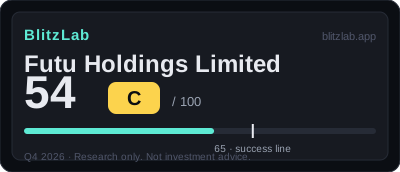
Futu Holdings Limited — Blitz Index 54 (C)
Futu scores 54 — online brokerage growing 30–68% with an 86% gross margin, held back by a CSRC fine, a US class action, and 90.3% of the votes in two hands.
Last re-scored: August 20, 2026.
Confidence: Medium · Category: platforms
Score breakdown
| Section | Score | Detail |
|---|---|---|
| A · Speed | 21 / 25 | FY2024 +35.8% → FY2025 +68.1% → first half +30.5%, Q2 +35.6% — three straight years of high growth, the highest speed in its batch |
| B · Moat | 34 / 60 | Network (B1 8) plus distribution (B2 9) plus market (B3 8) plus margin (B4 9) — a balanced moat, the strongest in its batch on B |
| C · Creative destruction | 11 / 15 | Digital brokerage displacing branch-based trading for a generation of investors — a real displacement, paced by regulation in each market |
| D · BlitzFailing | −12 | CSRC fine plus rectification and a class action (D4 −4); Li Hua 63.0% plus Tencent 27.3% = 90.3% of votes (D3 −3); fine accounting and cyclical revenue (D2 −3); margin-lending risk (D1 −2) |
Think we scored it wrong? Score it yourself →
Radar axes (0–100): Moat 56.7 · Speed 84.0 · Creative 73.3.
Watch item
Gates: G1 ✓ (confirmed — growth sustained: three straight years of high growth plus a second curve in prediction markets and overseas licences) · G2 ✓ (estimated, thin — the narrow definition is near or below the bar, the broad definition is 3.5×; TTM revenue of US$3.31B is ~18% of the online-brokerage market). 11 points below the 65-point threshold — first score. No FLAG: deductions of 12, three points of headroom. Without the deductions the score would be 66 — above the line. Watch: the CSRC final decision, the Tang v. Futu class action, and whether overseas expansion widens the G2 headroom.
Strengths
- High growth: FY2024 +35.8% → FY2025 +68.1% → first half +30.5%, Q2 +35.6%
- Customers, assets and volume all up 30% or more: paying accounts of 3.8M (+33.6%), client assets of HK$1.40T (+43.6%), Q2 trading volume of HK$6.42T (+78.8%)
- High margins: Q2 gross margin of 86.3%, first-half 86.7%, Q2 operating margin of 62.0%, net margin of 50.6%
- International expansion: Moomoo Prediction Markets (US), a Type A licence in Thailand, SFC approval for virtual-asset financing
- Capital strength: cash of HK$18,381.0M plus short-term investments of HK$6,612.0M, ~US$418M of buybacks in the first half
Concerns
- CSRC administrative penalty: a fine of ~RMB 1.85B (≈ US$271M), final decision not yet confirmed, two years of rectification, mainland accounts exit-only and no new mainland customers (D4 −4)
- US class action: Tang v. Futu (S.D.N.Y., filed 2026-06-26, lead plaintiff appointed 2026-10-15) (D4 −4)
- Governance: Li Hua at 63.0% of votes plus Tencent at 27.3% = 90.3% — a controlled company (D3 −3)
- Margin-lending risk: a balance of HK$91,875.6M with loan-loss provisions up 3.24× (D1 −2)
- Cyclical revenue: brokerage fees and interest income ride the equity-market boom (D2 −3)
Research notes
Thesis: a 66-point business scored at 54
Futu Holdings enters the BlitzLab record with a first scoring of 54 out of 100, grade C, built from Speed 21 out of 25, Moat 34 out of 60, Creative Destruction 11 out of 15, and deductions of 12. The total sits 11 points below the 65-point line, and the shape of the score is the story: speed converts to 84.0 — the highest in its batch — and the moat to 56.7, the strongest B total in its batch. The arithmetic is unusually clean: without the deductions the score would be 66, above the 65 line. The deductions are not operational. They are a CSRC fine of about RMB 1.85 billion with two years of rectification and mainland accounts placed exit-only, a US class action filed in June 2026, and a voting structure that puts 90.3% of the votes in the hands of Li Hua and Tencent.
The gates: both pass — the second only thinly
Gate 1, sustained growth or a second growth curve for a mature company, passes on a confirmed basis. Revenue grew 35.8% in fiscal 2024, 68.1% in fiscal 2025 and 30.5% in the first half, with paying accounts up 33.6% to 3.8 million and client assets up 43.6% to HK$1.40 trillion. Gate 2, a ten-year market ceiling at least ten times current revenue, passes as an estimate, thinly: the narrow definition is near or below the bar — trailing revenue of US$3.31 billion is already about 18% of the online-brokerage market — and only the broad definition reaches 3.5 times the bar. Overseas expansion into Thailand, Malaysia and the US is what widens the headroom. The fourth quarter of 2026 has not been reported at T, and its reporting date is unconfirmed — it is not a company-confirmed date and must not be presented as one — and no outcome is anticipated here. That is the balance of the record at T: the best business quality in its batch, capped by regulation and governance that the business cannot outgrow.
What the business is: a brokerage that monetises trading, margin and wealth
Futu Holdings runs the Futu and Moomoo apps, an online brokerage aimed at investors in Hong Kong, Singapore, Malaysia and other markets outside mainland China. It makes money in three ways, and the second quarter of 2026 shows the mix: total revenue of HK$7,200.2 million, of which brokerage commissions were HK$3,360.6 million (up 30.3% year on year), interest income — largely margin lending — was HK$3,123.8 million (up 36.5%), and other income, including wealth management, was HK$715.8 million (up 61.2%). The scale of the franchise is the paying-account base of 3.8 million, client assets of HK$1.40 trillion and quarterly trading volume of HK$6.42 trillion, of which US equities were HK$5.02 trillion and Hong Kong equities HK$1.17 trillion. Growth beyond brokerage comes from the second curve: Moomoo Prediction Markets in the United States from June 2026, virtual-asset finance under an SFC approval through PantherTrade, and a Type A licence in Thailand in July 2026 for Moomoo Thailand. What is closed is the mainland: new mainland customer inflow has stopped under a two-year rectification, with mainland accounts on an exit-only policy.
Why it scored 54: speed and margin at the top of its batch
Speed is 21 out of 25, converting to 84.0, the highest in its batch. Growth (A1, 8 of 10) is a three-year run — revenue up 35.8% in fiscal 2024, 68.1% in fiscal 2025 and 30.5% in the first half of 2026 — with trading volume up 78.8%, client assets up 43.6% and paying accounts up 33.6% in the second quarter. Capital speed (A2, 4 of 5) rests on net income of HK$3,641.9 million in the quarter (up 41.6%) and cash plus short-term investments of HK$24,993.0 million, enough to fund about US$418 million of buybacks in the first half from cash. Hiring and productivity (A3, 4 of 5) show revenue per employee of about HK$7.3 million on a headcount of 3,540, with revenue growing far faster than headcount. Share momentum (A4, 5 of 5) is the strongest single item: all three demand indicators grew more than 30%. The moat is 34 out of 60 (56.7): network effects 8, distribution 9, market size 8 and gross margin 9, the last on a gross margin of 86.3% in the quarter, an operating margin of 62.0% and a net margin of 50.6%. Creative destruction is 11 out of 15: the displacement of traditional brokerages (4), the irreversibility of mobile trading habits (4) and the lowering of investor transaction costs (3).
The risks: a regulator, a court and a voting structure
The deductions total 12, and they are the whole story of why a 66-point business scores 54. Regulation and social cost (D4, minus 4) is the largest: the CSRC's pre-notification of an administrative penalty in May 2026 proposed a fine of about RMB 1.85 billion — confiscation of about RMB 470 million plus a fine of about RMB 1.38 billion, roughly US$271 million — for unlicensed securities, fund and futures business in mainland China. The fine was fully reflected in first-quarter statements, cutting quarterly net income by 61.2% to HK$831.0 million, but the final CSRC determination is still unconfirmed. The same episode produced a US class action, Tang v. Futu Holdings, filed in the Southern District of New York in June 2026, with a lead plaintiff designated in October 2026 and a class period running from May 2023 to May 2026; the share price fell 27.5% on the day the penalty was announced. Governance (D3, minus 3) is structural: Class B shares carrying 20 votes each are held entirely by founder Li Hua and Huang River (Tencent), giving 31.7% of the equity 90.3% of the votes — Li Hua alone holds 63.0% — and the company is a Nasdaq-controlled company whose board is not majority independent. Revenue quality (D2, minus 3) reflects the fine's accounting and the cyclicality of a revenue base tied to market volumes. Debt (D1, minus 2) is not company borrowing but margin loans: a balance of HK$91,875.6 million, about 6.6% of client assets, with the loss allowance up 3.24 times in six months to HK$1,212.9 million.
What would change the score
The path up runs through the deductions, not the operations. Completion of the rectification and a final CSRC determination, together with resolution of the class action, would ease the largest single drag; the score file notes that without the deductions the total would be 66, above the 65 line. The governance deduction is harder to move: the voting concentration is a structural feature of the share classes, and only a change in that structure would lift it. On the positive side, the moat would strengthen if international expansion deepens the lock-in — Thailand, Malaysia and the United States are the markets that widen the thin Gate 2 headroom, where the narrow market definition sits near or below the bar and only the broad definition reaches 3.5 times it. The items to watch are the margin-loan loss allowance, which has tripled, and whether trading volume holds when Hong Kong and Chinese equity markets cool, since growth is partly tied to that boom.
More Platforms companies
Other Platforms names on the Blitz Index, highest score first: Alphabet (83/A), Meta (78/B), Airbnb (76/B).
Next earnings
Nov 19, 2026 · Before open · Confirmed
Coverage
Futu Holdings Limited · Next earnings unconfirmed at scoring · Score 54 · Grade C
Embed this score
Copy the HTML below to show this score on your site. The badge links back to this page and updates automatically when the score changes.
Preview:
BlitzLab scores businesses against a scholar’s standard — not investment advice. No price targets, no buy/sell recommendations. Figures are from SEC filings (XBRL) as labeled in the source scorecard.